Evaluating Recent Model Releases on GDPx
- Source
- newsletter.semianalysis.com
- Publisher
- SemiAnalysis
- Author
- Max Kan
- Date

Context
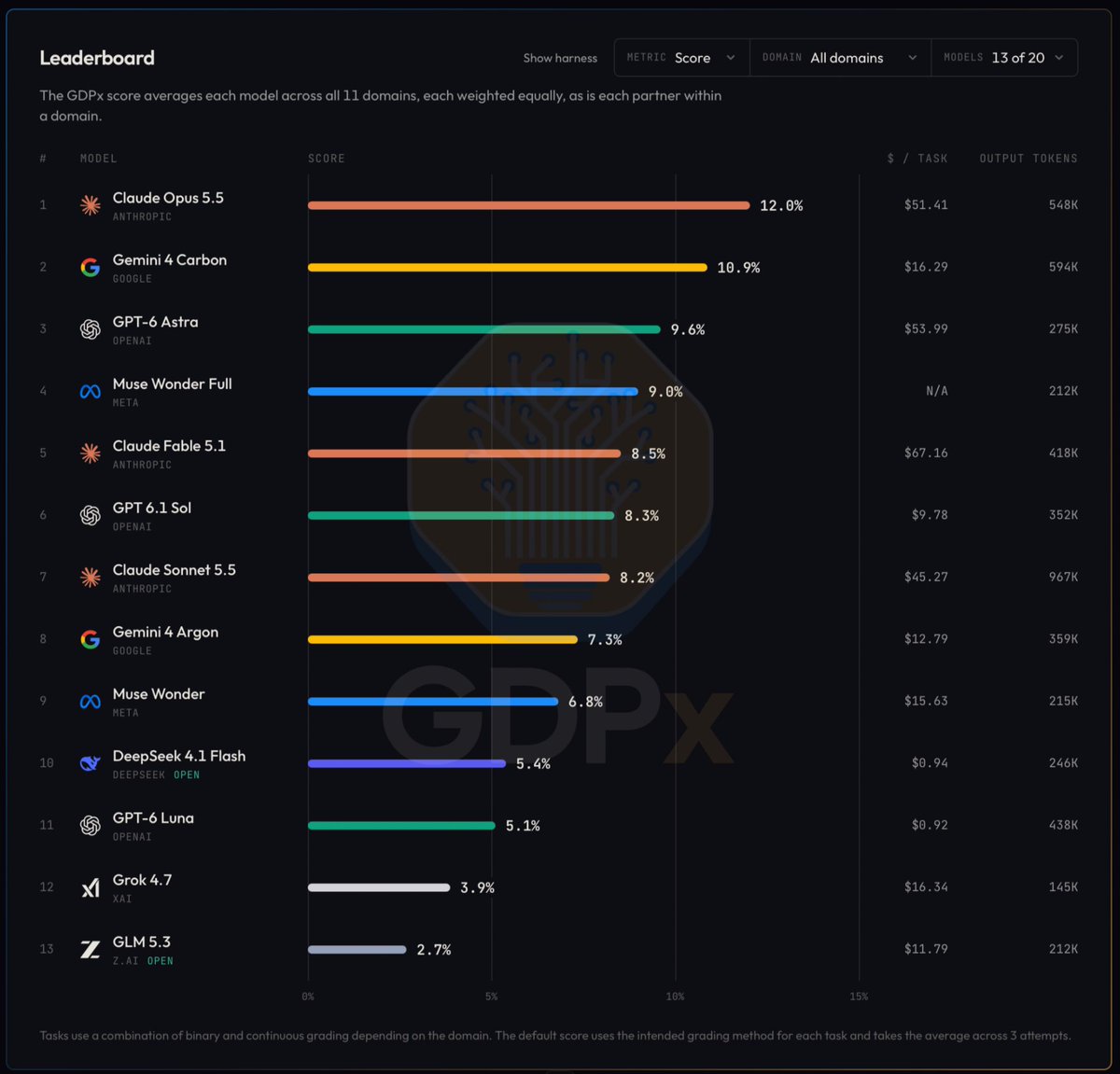
GDPx is a benchmark from the research firm SemiAnalysis, launched on November 1, with 206 tasks built with 14 specialist data partners in 11 fields it considers most valuable for frontier models, including chip design, finance, legal work and AI research itself. At launch the best score was Claude Opus 5.5's 12%. In an update after a month of new model releases, OpenAI's GPT-6.2 Astra ranks first at 19.3%, ahead of Anthropic's Claude Fable 5.2 at 16.4%, with Google's Gemini 4 Carbon the best of the other labs' models in fifth at 10.9%.
That order runs against the public reaction, which on X was harsh toward Astra and warm toward Gemini 4 Neon, sixth here at 10.1%. SemiAnalysis's explanation is in the per- scores. Astra excels at tasks that demand complex reasoning, such as hardware design, materials science and AI research, and it is the first model to score above 0% on the legal tasks. In software engineering, the field most people on X judge models by, it scores half of what Fable 5.2 does. SemiAnalysis also finds Astra too literal and unpleasant to work with, and attributes Neon's popularity to a cheerful manner rather than capability.
Two things qualify the ranking. Fable 5.2 and Astra lose points when their safety classifiers, filters that block requests in sensitive areas, stop cyber, biology or tasks. Leaving those fields out and giving partial credit on the legal and finance tasks, Astra scores 32.2% and Fable 29.9%, and SemiAnalysis says either leaderboard could be argued to be the correct one. Cost separates them further: at $88 and 1.23 million output tokens per task, Fable 5.2 costs 1.9 times as much as Astra and writes 3.9 times as many output tokens, for a lower score. All runs used each model's highest reasoning setting. The figures here come from the post's text: its charts were not read, and a final section for paid subscribers was not available.
- On SemiAnalysis's GDPx, GPT-6.2 Astra leads at 19.3% and Fable 5.2 is second at 16.4%. Excluding cyber, bio and alignment, where safety classifiers can trigger, and using partial grading, the gap narrows to 32.2% against 29.9%.
- Fable 5.2 was the costliest model SemiAnalysis ran: $88 and 1.23M output tokens per task, 1.9x 6.2 Astra's cost and 3.9x its output tokens for a lower overall score. SemiAnalysis attributes much of this to and spawning subagents for testing and review.
- Software engineering is where Fable 5.2 leads, at 24.4% against 8.9% for Opus 5.5 and 15.6% for 6.2 Sol, while 6.2 Astra scores half of Fable there. SemiAnalysis says that gap explains Astra's poor reception among X users, who mostly judge models on coding.
- SemiAnalysis attributes Gemini 4 Neon's enthusiastic reception to pleasant behavior rather than intelligence: GDPx puts Google behind Anthropic and OpenAI in nearly every domain, and Neon's top biology score likely reflects more lenient safety classifiers.
- Weaker made Neon expensive to run: its GDPx run cost $15,286, and at 6.2 Astra's cache hit rate it would have cost $10,403, about 32% less. Google shipped a caching update the same day that SemiAnalysis estimates cuts that bill roughly 17-18%.
- Field — One named piece of a record, such as name or approved_on; a record is one entity's set of values, one per field.
- alignment — The work of making AI systems actually pursue what their builders and users intend, rather than something subtly or dangerously different.
- Persistence — The property of surviving beyond the process that produced the information, usually by being written to a file.
- prompt caching — Reusing the model's processed form of a repeated prompt prefix so subsequent calls skip re-reading it, cutting cost and latency substantially.